
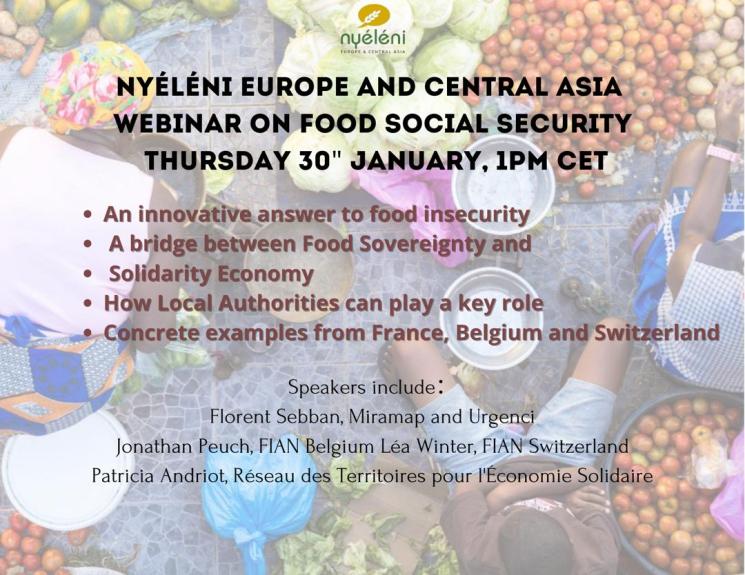
The Nyéléni ECA Food Sovereignty movement has launched its much-anticipated series of online thematic webinars. These monthly sessions aim to bring together member organizations and civil society actors to engage in meaningful dialogue, share insights, and learn from one another's experiences on the most pressing issues related to food sovereignty. The third webinar, hosted by Urgenci, focused on Food Social Security and gathered voices from France, Belgium, and Switzerland. It explored how this rights-based approach can serve as a bridge between Food Sovereignty and the Solidarity Economy, while offering practical, systemic solutions to food insecurity across the region.
On 30 January 2025, the Nyéléni Europe and Central Asia (ECA) movement hosted a powerful webinar on Food Social Security, led by Urgenci, bringing together perspectives from France, Belgium, and Switzerland. The session explored how this emerging concept can serve as a bridge between Food Sovereignty and the Solidarity Economy, while offering a practical response to the growing challenge of food insecurity across the region.
Food Social Security is a rights-based approach that seeks to ensure universal access to healthy, local, and culturally appropriate food, while providing decent livelihoods for small-scale food producers. Inspired by Latin American models like Brazil’s Bolsa Familia, this system is currently being piloted in various European localities. It often takes the form of a monthly allowance distributed via prepaid cards, which can be used in selected local food systems—such as CSA schemes, cooperatives, or organic shops—thus supporting both consumers and producers.
Speakers included Florent Sebban (Miramap, Urgenci), Jonathan Peuch (FIAN Belgium), Léa Winter (FIAN Switzerland), and Patricia Andriot (Réseau des Territoires pour l’Économie Solidaire), who each shared rich insights into how local authorities are shaping and supporting these initiatives. Their contributions highlighted not only the concrete impacts of pilot programs, but also the policy and funding frameworks that make them possible.
The discussion revealed that Food Social Security can offer a real alternative to the charity-based food aid model, while fostering stronger and more equitable local food systems. It is a promising direction for those committed to systemic change—grounded in dignity, sustainability, and solidarity.
Watch the full webinar here:
https://youtu.be/NTEt8QESbjU?feature=shared